
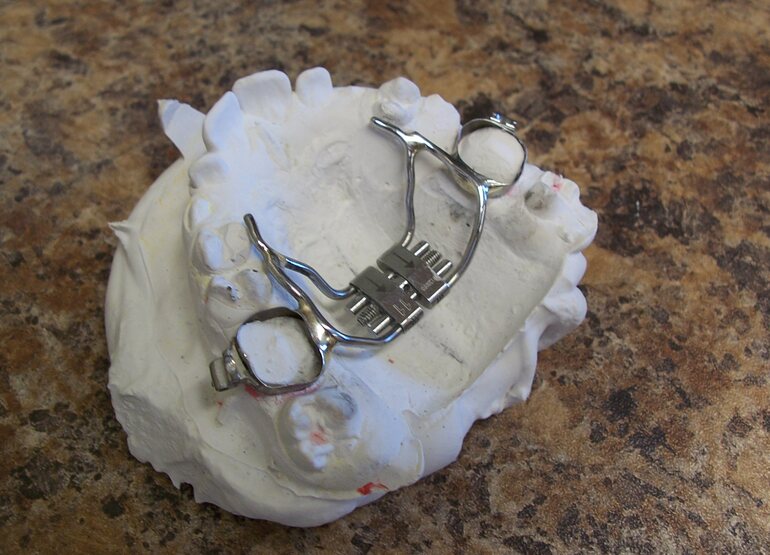
Many childhood habits and genetic traits risk an improper growth of permanent teeth later on. Relief comes in the form of early orthodontic treatments, which can begin in a child as young as seven years old and significantly reduce the risk of conditions such as crowded or crooked teeth and jaw problems. One such treatment uses orthodontic expanders.
What is a Palate Expander?
Children who have a crossbite issue lack the space for permanent teeth to grow correctly. Palate expanders are cemented plates placed on the roof of your child’s mouth to widen the jaw and create more space. They work on the principle that the bone structures in children and preteens are still in their growing phase and hence more susceptible to widen easily.
How do Palate Expanders Work?
The shape of your child’s jaw expander will depend on his/her jaw structure and hence is custom-made to complement the natural shape. The expander is made of two separate sides joined by a screw in the middle. Once it is cemented inside the mouth, it will be your job to turn that screw using a special key as instructed by the orthodontist. The gentle pressure created with this tightening will shift the bones and eventually create the required space. Stabilizing the change will require leaving the plate in place for a few months.
Types of Palate Expanders for Kids
Depending on the age of your kid and the shape of their palate, the orthodontist will suggest either of the below-mentioned palate expanders:
- Removable Palatal Expander
– Usually suggested in case of minimal expansion, these work similar to a retainer but need tightening the screw once or twice daily.
- Rapid Palatal Expander (Fixed Expander)
– Ideal for a more thorough treatment, it comes with a center screw and branches that are glued to the molars of the upper jaw. There are three types of fixed expanders, namely:
-
-
- Hyrax
- Quad helix
- Haas expander
-
Does Your Kid Need a Palate Expander?
There are three primary conditions wherein a palate expander could help protect your kid’s permanent teeth growth. The orthodontist will suggest a maxillary expansion for your kid in case of:
- Impacted Teeth
– Occurs when the permanent tooth gets trapped inside the gum due to a narrow palate and moves in the wrong direction, causing extreme pain.
- Crowded Teeth
– A narrow palate forces the teeth to squeeze together, leading to bunching, overlapping, or angling.
-
Crossbites
– When the upper molars bite on the bottom molars, it causes gum disease and tooth chipping.
At What Age Should a Kid Get a Palate Expander?
In the early ages of a child’s life, they carry a soft spot on the roof of their mouths, solidifying with a bony structure once they hit puberty. That weak spot allows an easier transition from a narrow palate to a wider one with a palate expander in children between the ages of 8-12.
Does An Orthodontic Expander Hurt?
When planned and executed at an early age, the expanders do not hurt since there is no bone in the upper jaw, allowing for an effective expansion. However, your kid could feel a light pressure for a few seconds during the turning of the screw.
Relying on a palate expander to widen the roof of your child’s jaw will ensure that they grow up with a healthier teeth placement. Since it restructures the entire jaw, you must encourage your child to take care of the expander during the course of the treatment for desired results.
Book an appointment with your orthodontist and ensure your child attains a healthy smile at the earliest.

Dr. Brian Thurman has spent his entire life enjoying all the beauty that California has to offer. A Fresno native, he still escapes to the ocean or the mountains whenever his busy schedule allows. Driven by his love for natural beauty, Dr. Thurman enjoys creating beautiful smiles and healthy bites that last a lifetime. He is proud to be the only Ivy League trained Orthodontist in the Fresno/Clovis area.